Real-Time Decision-Making: How AI and Low-Latency Computing Are Reshaping Digital Twins
Digital twins have long been understood as high-fidelity replicas of the physical world. Whether modeling entire cities through GIS systems or capturing the intricate details of buildings and factories via BIM, the traditional approach has focused on creating precise digital mappings of reality to enable simulation, analysis, and operational planning.
But this paradigm is shifting.
The AI-Driven Transformation
With the integration of artificial intelligence, digital twins are rapidly evolving beyond their original purpose. They are no longer confined to passively mirroring physical systems — instead, they're becoming active participants in decision-making processes, capable of reasoning, testing hypotheses, simulating strategic interactions, and generating predictive insights.
This transformation is perhaps most visible in digital platforms and e-commerce environments. Companies now deploy agent-based digital twins to simulate the behavior of millions of users: how they respond to advertisements, whether they convert under different pricing strategies, and how they interact with product recommendations.
The objective has fundamentally changed. These digital twins aren't designed to perfectly replicate the real world — their primary goal is to maximize decision value in real time.
Challenge 1: The Latency Divide
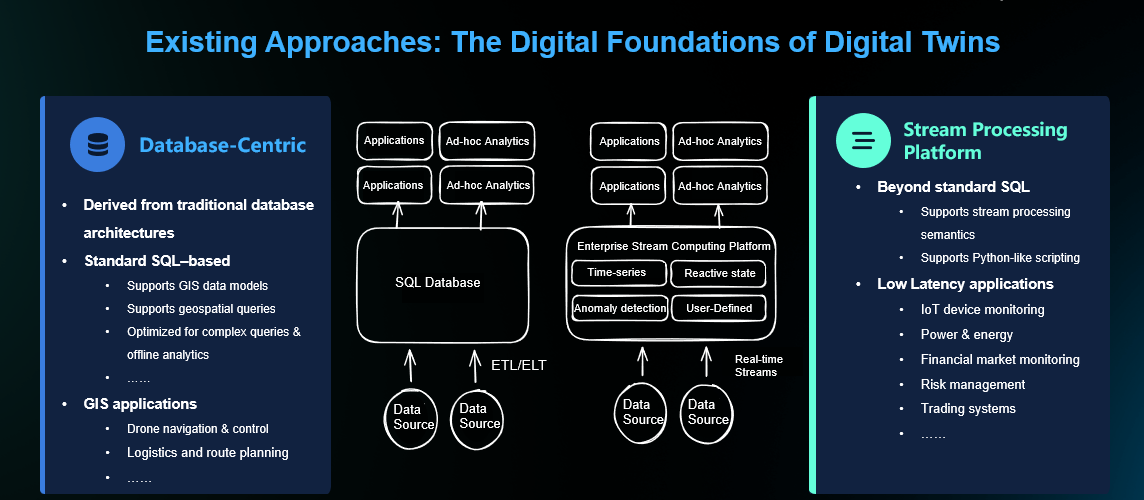
As digital twins transition from visualization tools to decision engines, two distinct architectural paradigms have emerged — each optimized for different use cases.
Traditional database-centric architectures excel at complex queries and offline analytics. Built on mature SQL foundations and proven data models, they power GIS platforms, engineering simulations, and industrial modeling. But they share a critical limitation: high latency. Computation cycles often span minutes or hours — acceptable for design validation and offline planning, but inadequate when immediate response is essential.
Stream processing platforms are fundamentally different. Purpose-built for real-time reaction, they support streaming semantics and flexible scripting models, making them ideal for IoT monitoring, power markets, and financial trading systems. In these domains, characterized by massive time-series data and continuous event streams, success depends on reacting to changes in real time.
The difference between second-level, millisecond-level, or microsecond-level latency often determines business outcomes.
DolphinDB's low-latency streaming engine now delivers decision response times in microseconds while maintaining stable performance under multi-threaded concurrency. This enables digital twins to move beyond post-event analysis and truly power real-time decision-making.
Challenge 2: From Human-Centric to Agent-Centric Design
Beyond the pursuit of lower latency, another fundamental shift is reshaping digital twin architectures: the changing nature of users.
Traditional software systems are human-centric by design. Humans write rules, tune parameters, and deploy systems. But in AI-driven digital twin scenarios, an increasing share of decisions will be executed autonomously by intelligent agents.
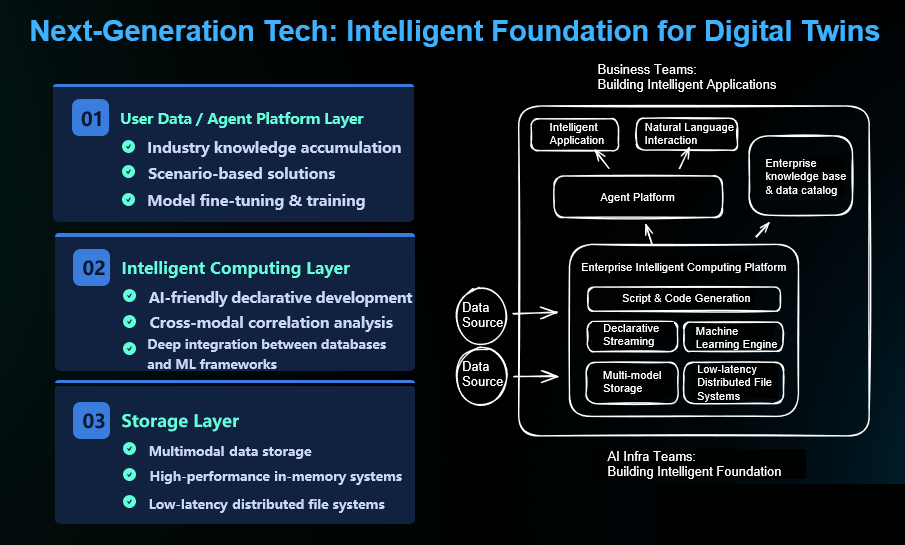
This shift demands an Agent-Friendly Architecture — not merely faster computation, but a fundamental redesign of compute, storage, and scheduling around AI workloads. Key requirements include:
- CPU-GPU coordination for hybrid inference
- Intelligent model scheduling and resource allocation
- Native support for vector databases and multimodal data
A Layered Architecture for Next-Generation Digital Twins
The most effective approach structures digital twin infrastructure in three distinct layers:
User Data Layer (Top)
Contains an enterprise's most critical and proprietary domain knowledge. This data cannot be externalized or fully entrusted to public models — its value comes from deep, contextualized utilization within the enterprise.
Intelligent Computing Layer (Middle)
Goes beyond traditional SQL execution engines to support AI-native development paradigms, cross-modal data association, and deep integration with machine learning frameworks.
Storage Layer (Foundation)
Provides multimodal storage capabilities, high-performance in-memory systems, and low-latency distributed file architectures.
DolphinDB: Building an Intelligent Digital Twin Foundation
In DolphinDB's architecture, a digital twin is not an isolated application-layer concept, but a system-level capability supported by a unified platform.
Unified compute architecture: DolphinDB's integrated database and streaming engine enables batch processing, real-time computation, and complex analytics to run on a single platform — eliminating latency and consistency issues caused by data movement across multiple systems.
Intelligent automation: While traditional low-latency streaming systems offer powerful capabilities, they often require complex manual design and operational expertise. DolphinDB addresses this through declarative expressions and automated reasoning — allowing users to focus on data semantics and business logic while the system automatically derives optimal storage layouts, computation topologies, and deployment strategies.
The Road Ahead
As digital twins enter an era defined by real-time decision-making and AI autonomy, the fundamental question is no longer whether a system can faithfully replicate reality — but whether it can complete the full loop of perception, memory, and decision-making under ultra-low latency.
In this new paradigm, DolphinDB continues to advance its capabilities in low-latency computing, intelligent data management, and AI-friendly architecture — providing a robust and forward-looking foundation for the next generation of digital twins.
The digital twins of tomorrow won't just help us understand systems better. They'll help us make better decisions, faster, in an increasingly complex and dynamic world.