Case Study | How a Leading Broker Achieved 100× Faster Market Data Analytics
As a core infrastructure within financial institutions, the Market Data Center provides critical capabilities including real-time market data ingestion, analytics computation, data storage, and enterprise-wide distribution. It serves as the foundational platform enabling trading execution, portfolio management, and risk control across the organization.
The rapid evolution of global capital markets—driven by algorithmic trading, high-frequency strategies, and quantitative investment approaches—has significantly increased demand for tick-level and microstructure data among trading desks, asset managers, and institutional investors. However, legacy market data architectures are increasingly unable to meet these requirements, constrained by limited throughput, high query latency, and inflexible development frameworks. These limitations have become critical barriers to digital transformation and data-driven decision-making.
To address these challenges, leading financial institutions are adopting DolphinDB to build next-generation market data platforms. Leveraging DolphinDB's high-performance distributed computing architecture, these organizations have transformed their data services from batch-oriented, end-of-day processing to sub-millisecond real-time analytics. This enables the Market Data Center to evolve into a unified stream-batch platform for research, backtesting, and simulation—enhancing trading performance, accelerating alpha discovery, and strengthening enterprise risk management.
The Challenge: Throughput, Latency, and Architectural Fragmentation
Over the past decade, securities markets have experienced exponential growth in asset classes, trading volumes, and operational complexity. With expanding coverage across global exchanges and the proliferation of cross-border investment strategies, market data centers now manage data from 20+ markets spanning over 100,000 securities across equities, fixed income, derivatives, and alternative assets.
To support modern trading and investment operations, market data centers must deliver excellence across three critical dimensions: real-time data distribution, high-performance storage and retrieval, and low-latency analytics. Traditional architectures face significant limitations in each area:
Real-Time Data Ingestion and Distribution
“At peak market times, tick-level data can surge beyond 500,000 messages per second, and we still need to process it within sub-millisecond latency,” noted a technology leader at a leading global firm. He explained that legacy architectures simply cannot deliver the throughput or efficiency required for this level of performance, which in turn undermines trading accuracy and market oversight.
High-Performance Storage and Query
Beyond real-time distribution, market data centers must provide efficient storage and rapid query access to multi-year tick histories. Traditional row-based databases (e.g., MongoDB, MySQL) deliver suboptimal compression ratios and limited query performance as datasets scale into the hundreds of billions of records. Cross-asset analytical queries that should complete in seconds often require 10+ minutes, creating bottlenecks for backtesting, research, and regulatory reporting.
Low-Latency Derived Analytics
Raw market data must be transformed in real time into actionable insights—order book reconstruction, trade signal generation, alpha factor calculation, and market microstructure analytics. General-purpose streaming frameworks (Spark, Flink) and custom Java implementations typically exhibit latencies exceeding 100ms and lack native support for financial domain logic, making it difficult to implement complex calculations such as VWAP attribution, liquidity scoring, or multi-venue order matching efficiently.
Fragmented Technology Stack and Operational Complexity
Most legacy platforms comprise multiple disparate systems: C++/Java for data acquisition, Flink/Spark for stream processing, ClickHouse/MongoDB for storage, and Python for analytics. This architectural fragmentation results in high operational overhead, prolonged troubleshooting cycles, and extended time-to-market for new analytics capabilities—often requiring months to deploy new factors or trading signals into production.
Building a low-latency, high-throughput platform with agile streaming analytics capabilities has become an urgent priority for securities firms and asset managers modernizing their market data infrastructure.
The DolphinDB Solution: Unified Platform Architecture for Modern Market Data Infrastructure
As a high-performance time-series computing platform, DolphinDB integrates native database storage, streaming analytics, and advanced computational tools into a single system.
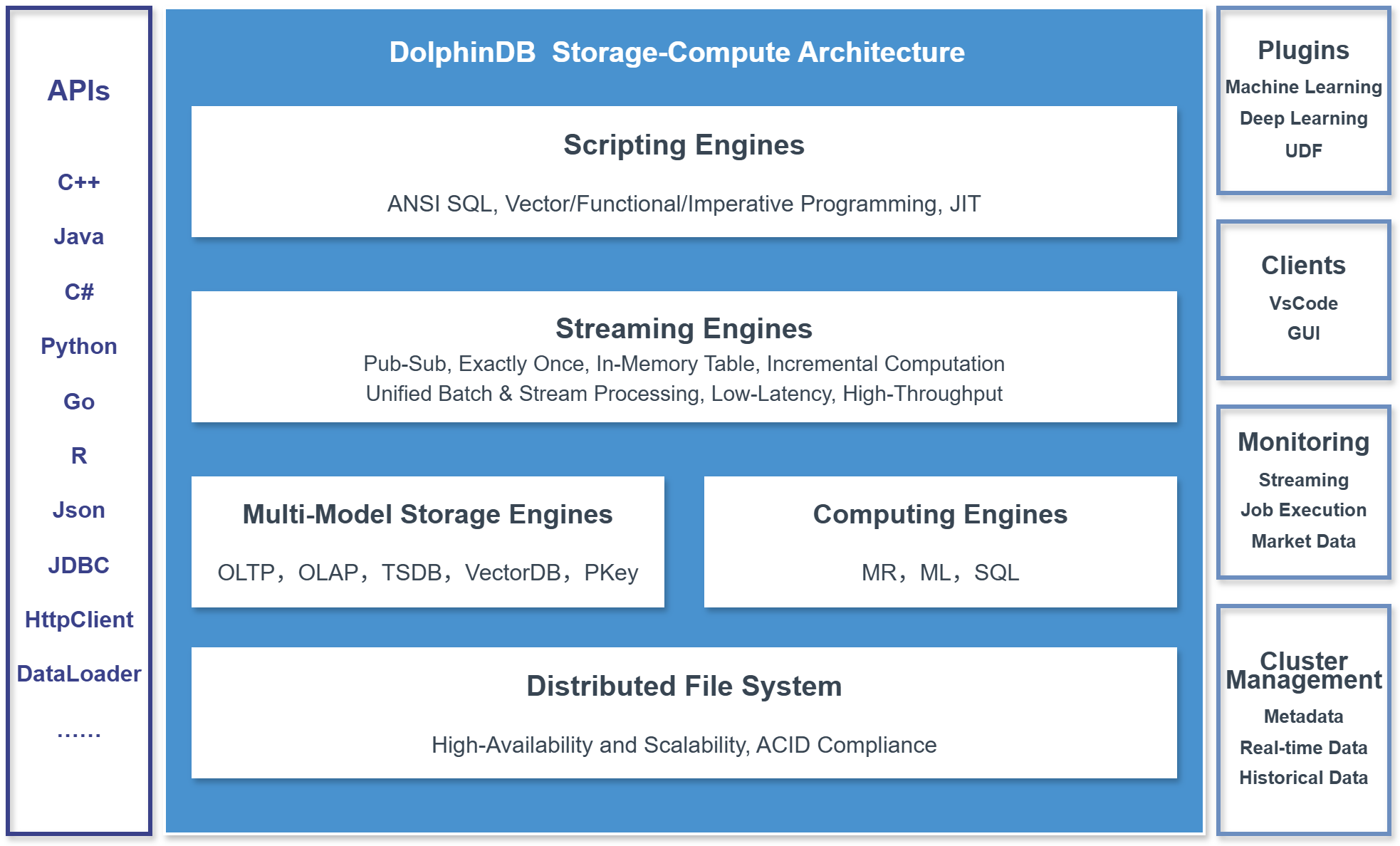
Unlike conventional approaches that layer incremental optimizations onto legacy architectures, DolphinDB delivers a ground-up redesign of the entire data lifecycle—from ingestion and storage through computation and distribution. This unified architecture enables financial institutions to operate data as a strategic asset, significantly enhancing throughput, reducing latency, and accelerating development cycles for market data processing and derived analytics.
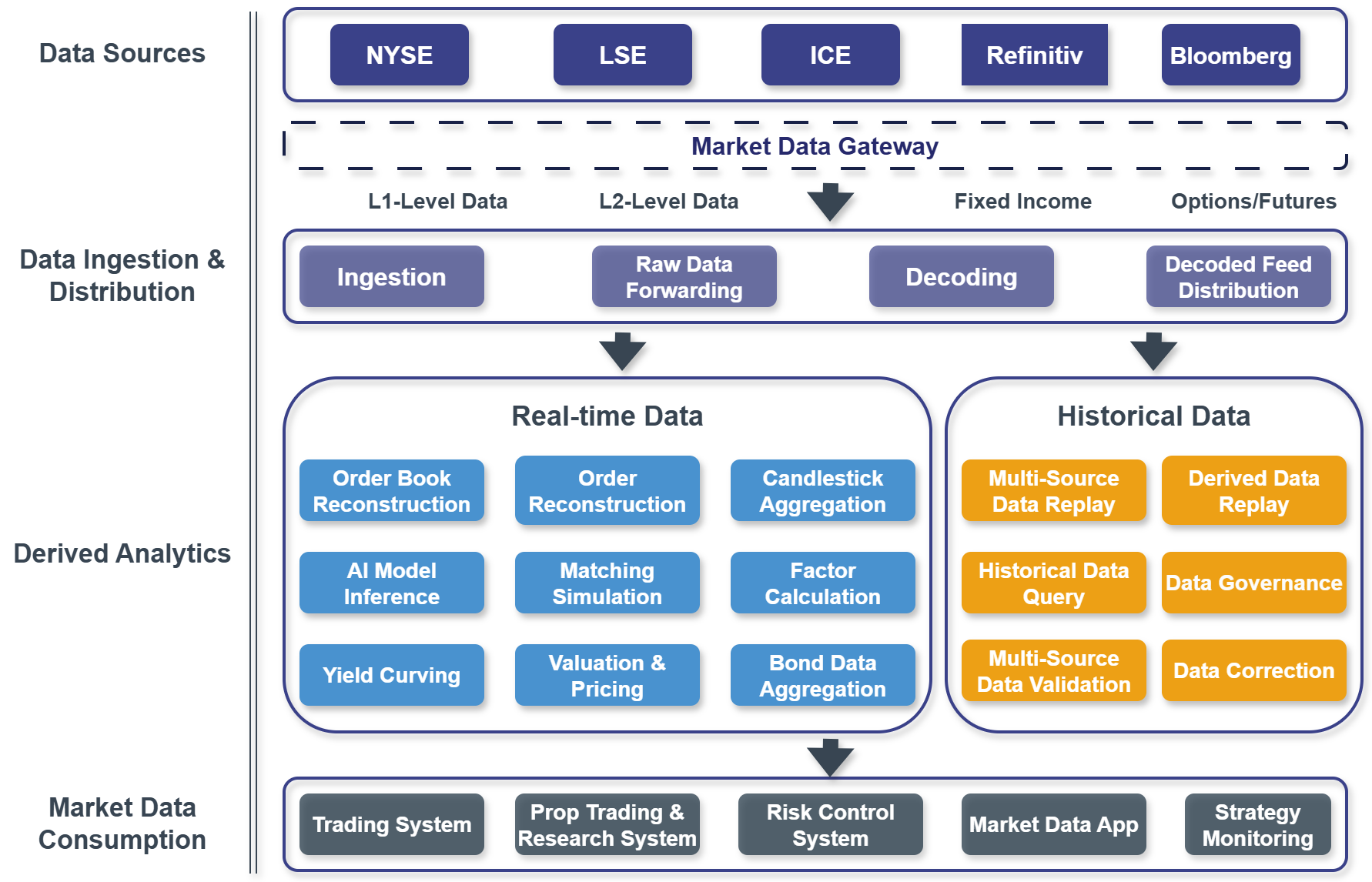
Storage Architecture
DolphinDB's multi-model storage engine is purpose-built for financial market data, offering specialized capabilities including:
- Duplicate-timestamp handling for high-frequency tick data
- Array-vector storage for multi-level order book depth
- Wide-table and data co-location for efficient order-trade matching
- Hybrid time-series and relational data models
- Enterprise-grade high availability and disaster recovery
Computational Framework
DolphinDB provides a comprehensive analytical ecosystem featuring 2,000+ built-in functions, multiple streaming engines, and domain-specific components that enable:
- Cross-sectional and panel data transformations
- Time-aware joins
- Unified stream-batch processing workflows
- Historical data replay with time-travel simulation
- Multi-paradigm programming support (SQL, Python-like scripting)
- Just-in-time (JIT) compilation for performance optimization
This integrated design eliminates the operational complexity and performance overhead of multi-system architectures, delivering a streamlined platform for real-time analytics, backtesting, and production trading systems.
The Gains: From Cost Center to Strategic Asset
DolphinDB's unified architecture eliminates the operational complexity of managing disparate systems for ingestion, processing, and storage. By consolidating real-time streaming, analytics, and historical data management into a single platform, institutions have significantly reduced infrastructure and development costs.
Leading securities firms and asset management institutions have deployed next-generation market data centers on DolphinDB, achieving measurable transformation across three critical dimensions:
| Dimension | Legacy System | DolphinDB | Improvement |
|---|---|---|---|
| Real-time Computation Latency | 100–1000 ms | ≤ 5 ms | 20–200× |
| Historical Query Response | 10+ minutes | ≤ 1 second | 100× |
| New Strategy Deployment | 3 months | 2 weeks | 85% faster |
Performance: From Batch Processing to Sub-Millisecond Analytics
Production deployments across multiple institutions demonstrate substantial performance gains:
In-Memory Data Tables
- Record write latency: ≤ 10 μs
- Key-value updates (latest snapshot): ≤ 10 μs
- Query performance (10M records): ≤ 20 ms
Real-Time Streaming Analytics
- Reactive state engine: market data ingestion → factor calculation → signal generation in ≤ 10 ms end-to-end
- Order book reconstruction (configurable snapshot generation): ≤ 600 ns per tick
- Order flow reconstruction: ≤ 500 ns per event
- Matching engine simulator: ≤ 1 μs per order execution
High-Performance Storage
- Columnar time-series architecture with ZSTD compression reduces storage footprint by 10×
- Composite partitioning strategy enables sub-50ms aggregations on trillion-row datasets
One leading securities firm compressed petabyte-scale tick data to 300 TB—cutting storage costs by 70% while improving query performance
Agility: Accelerating Strategy Innovation
Beyond raw performance, DolphinDB fundamentally enhances business agility. The unified stream-batch architecture enables quantitative researchers to develop, backtest, and deploy strategies using a single codebase—eliminating the traditional friction between research and production environments.
Built-in components for historical replay, high-frequency backtesting, order book reconstruction, and valuation analytics enable rapid assembly of new analytical services.
At one tier-one securities firm, strategy deployment cycles decreased from 3 months to 2 weeks following DolphinDB adoption.
In highly competitive financial markets, technical inefficiency translates directly to lost opportunity. The cost savings, accelerated development cycles, and real-time analytical capabilities enabled by DolphinDB create compounding competitive advantages—transforming the market data center from a back-office cost center into a front-office profit engine that drives alpha generation, operational excellence, and strategic differentiation.