From T+1 to Real Time: DolphinDB Powers Next-Gen Strategy P&L Platforms for Full-Asset Risk Control
As proprietary trading, asset management, and derivatives operations expand rapidly, securities firms increasingly require real-time P&L calculation and risk monitoring capabilities for multi-asset strategies. Traditional T+1 accounting models no longer satisfy the demands of intraday dynamic risk control.
To address this challenge, leading securities firms have adopted DolphinDB as their technology platform to build next-generation real-time strategy position P&L monitoring systems. These platforms effectively resolve the limitations of legacy architectures in critical areas including real-time responsiveness, complex valuation computations, and cross-asset correlation analysis.
The new systems deliver millisecond-level P&L measurement across all asset positions, real-time tracking of dynamic risk exposures, and automated anomaly detection and alerting—advancing risk management capabilities toward full real-time operation and intelligent automation.
The Challenge: A Complex and Diversified Business Environment
The rapid expansion and diversification of securities operations have created significant challenges for firms.
Aggregating position data in real time across multiple markets —including equities, bonds, and derivatives—requires managing over 100,000 securities instruments across more than 10 exchanges, each governed by different rules, resulting in substantial data processing complexity.
Compounding this challenge, P&L calculations and risk assessments must be completed within milliseconds to support effective intraday decision-making, while the system must simultaneously handle computationally intensive tasks such as dynamically calculating derivative valuations, bond accrued interest, and foreign exchange translations using real-time market data.
These demands are further complicated by fragmented systems , where traditional risk control platforms operate in isolation from trading and clearing systems, causing data latency that delays risk monitoring and undermines the ability to respond swiftly to market movements.
These challenges have exposed critical bottlenecks in legacy system architectures:
Batch Processing Delays
- P&L calculations using Java and traditional databases operate in batch mode, requiring minutes to complete and preventing effective intraday risk control.
- Complex derivative valuations depend on end-of-day offline processing and cannot reflect position risks in real time.
Inefficient Cross-Asset Analysis
- Correlation queries across hundreds of billions of position and market data records on relational databases like MySQL can exceed five minutes.
- Risk exposure aggregation relies on rigid, pre-built ETL workflows that lack operational flexibility.
Fragmented Technology Stack
- Deployments combining multiple components—such as Flink, Java, and Doris—increase development and maintenance overhead.
- Separation of real-time and batch computation logic makes it difficult to ensure consistency in risk strategy execution.
The DolphinDB Solution
To overcome these bottlenecks, DolphinDB has enabled securities firms to build an integrated real-time "position–market data–risk" monitoring platform that spans data storage, computation and analytics, and business applications. Built on DolphinDB's high-performance time-series database and unified stream-batch processing architecture, the platform combines real-time streaming and batch computing capabilities to support risk indicator calculations, trading analytics, and diverse financial engineering models. This enables unified management and computation across multi-modal, multi-asset datasets, effectively powering intelligent quantitative investment and risk management applications.
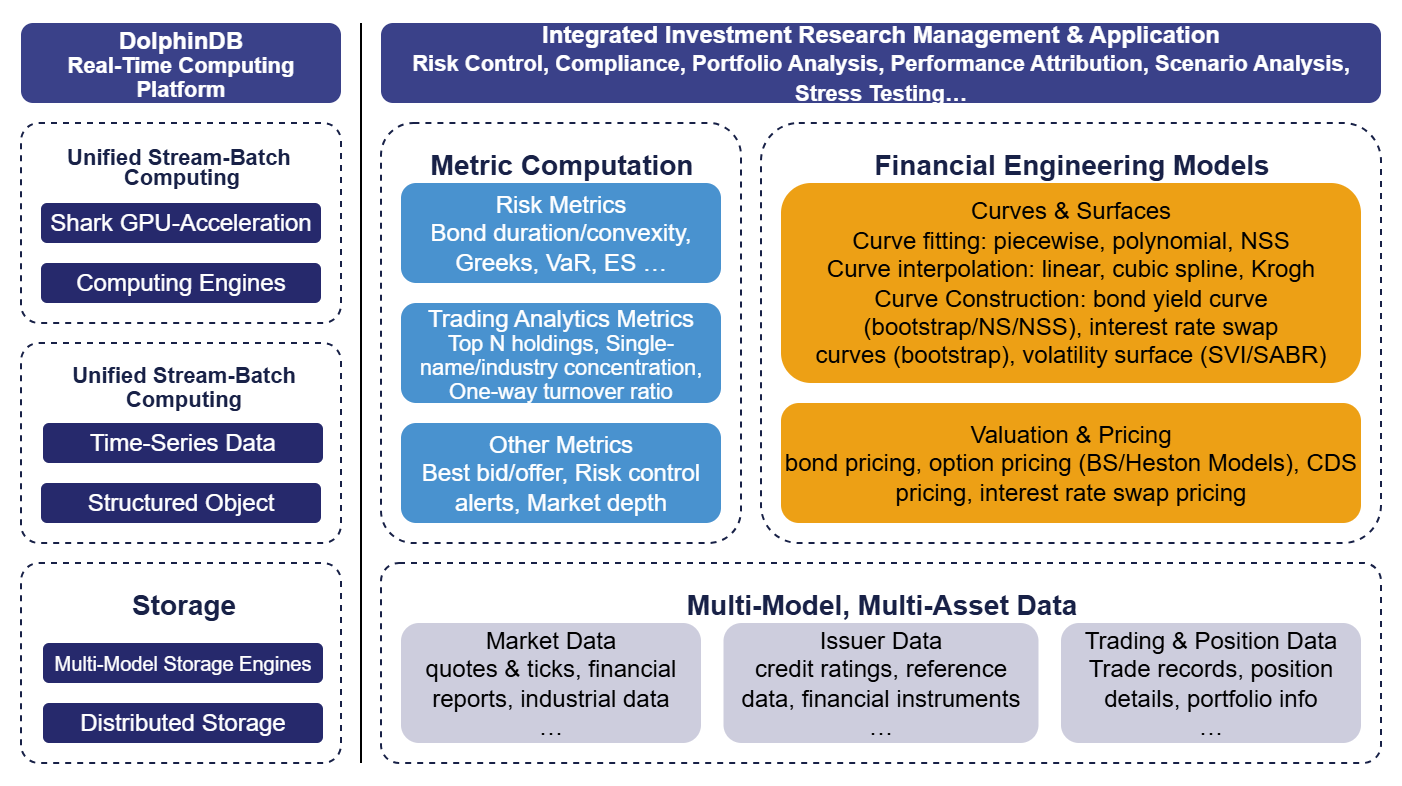
Through technological innovation, the platform delivers transformative capabilities across real-time computation, risk control, data governance, and business collaboration, dramatically improving both computational efficiency and response speed for P&L monitoring:
Real-time Position P &L Computing Engine. DolphinDB leverages in-memory tables to achieve millisecond-level joins between position and market data, maintaining single P&L calculation latency under 1 millisecond. Built-in models for bond accrued interest, option Greeks, and other valuations, combined with dynamic parameter adjustment, enable accurate and timely position P&L calculations.
Unified Stream-Batch Risk Control Framework. A responsive state engine computes indicators such as VaR, leverage ratios, and concentration metrics in real time, with end-to-end latency under 10 milliseconds. Historical batch backtesting and real-time stream computation share identical scripts, ensuring risk control strategy consistency and enabling firms to maintain stable risk defenses across varying market conditions.
Multi-Model Storage and High-Performance Querying. Through composite partitioning strategies and columnar storage for time-series data with ZSTD compression, the platform delivers query response times under 100 milliseconds for tens of millions of historical position records. It supports rapid multi-dimensional analysis across asset types, time periods, and other attributes, providing comprehensive visibility into position risk.
Function Views to Eliminate Business Silos. The platform maps positions, market data, and risk indicators into unified function views, enabling business teams to invoke complex risk control logic directly through SQL queries, dramatically simplifying operations. Development cycles for new monitoring metrics have been reduced from weeks to hours, substantially accelerating business innovation.
The Gains
Deployment of this next-generation real-time strategy position P&L monitoring platform has delivered substantial performance improvements and business value for securities firms.
Computational efficiency has increased by an order of magnitude. P&L calculations have been optimized from minutes to milliseconds , while risk indicator refresh frequency has accelerated 100-fold , dramatically enhancing real-time responsiveness. Query performance has improved equally—cross-asset risk exposure analysis has been reduced from 10 minutes to under 1 second. The streamlined technology stack has also reduced operational and maintenance costs by 50%.
Beyond performance gains, the platform unlocks advanced capabilities including intraday stress testing and dynamic margin calculation, enabling firms to shift full-asset risk management from reactive response to proactive prevention.
DolphinDB's proven success in risk monitoring offers valuable insights for the financial sector. Real-time risk control has become the industry standard, with the shift from "T+1 accounting" to "second-level intervention" establishing unified stream-batch architecture as the essential foundation for modern risk control systems. This has enabled an agile risk management paradigm where DolphinDB's function views allow business users to participate directly in rule configuration, improving risk strategy iteration efficiency by a factor of 20 and accelerating firms' ability to adapt to evolving market conditions.