On May 28, 2026, Dr. Xiaohua Zhou, Founder and CEO of DolphinDB, was invited by the Peking University to deliver the 49th lecture in the Financial Engineering Leaders Forum series, presenting " Differentiated Paths for Quantitative Investment in the Age of AI Agents " to foster in-depth dialogue between academia and industry on AI-driven quantitative finance.
1. Collective Intelligence: The Next Frontier, with Finance as Its Ideal Application
Artificial intelligence is evolving from perceptual intelligence and cognitive intelligence toward collective intelligence, where multiple AI agents collaborate autonomously to accomplish complex tasks. While perceptual intelligence has largely matured and cognitive intelligence is approaching its current limits, collective intelligence has become the next major frontier.
Dr. Zhou explained that finance provides an ideal environment for AI agents for three reasons: it is inherently digital, operates in a continuously evolving competitive environment, and places exceptionally high value on decision-making. Together, these characteristics create sustained demand for diverse AI agents capable of supporting increasingly sophisticated financial workflows.
Unlike many other software applications, quantitative investment cannot rely on disposable, one-off code. Its stringent requirements—including low tolerance for errors, full traceability, rigorous data standards, high-performance computing, and the need to balance standardization with customization—make a robust engineering foundation indispensable.
To reconcile engineering discipline with development flexibility, Dr. Zhou outlined three complementary approaches:
- Flexible Software Architecture: AI agents serve as the "brain" that interprets user intent, while high-performance infrastructure provides the execution backbone and data serves as the foundation that continuously powers the system.
- Configuration-Driven Development with AI Code Generation: Business logic is defined through configurable models, allowing AI to interpret investment strategies while standardized templates handle execution. This approach minimizes repetitive development while balancing customization, efficiency, and system stability.
- AI-Assisted User Interfaces: By combining generative AI with intuitive interfaces, users can generate strategies through natural language interactions, enabling investment professionals without extensive programming experience to participate directly in strategy development.
Rather than competing with one another, these approaches can be adopted according to an institution's stage of development and strategic priorities.
2. Building Competitive Advantage Across Six Dimensions
Building on a solid engineering foundation, six key areas where quantitative investment firms can differentiate themselves.
2.1 Data Infrastructure
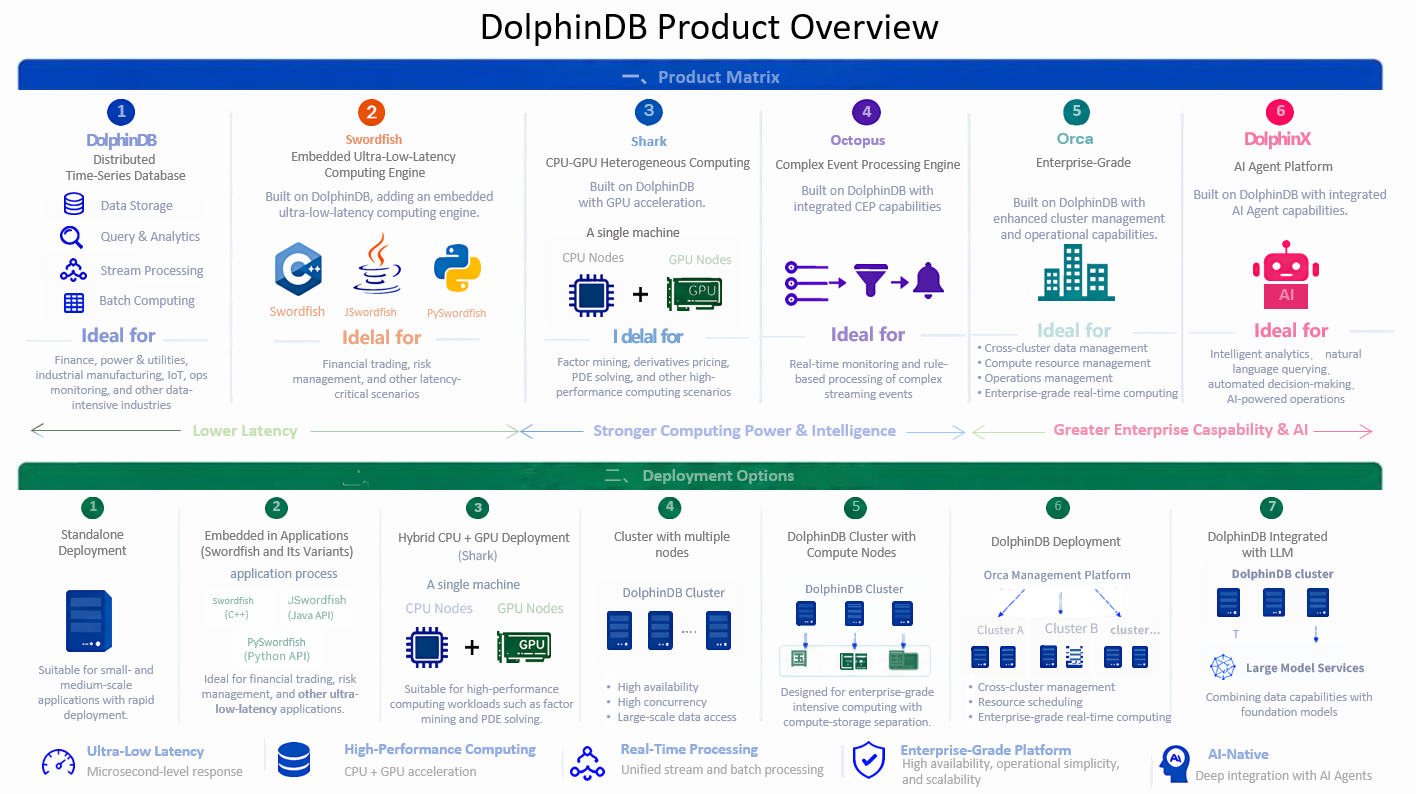
As traditional market data becomes increasingly commoditized, alternative and proprietary datasets are emerging as important sources of alpha. DolphinDB's multi-model data platform supports seven data modalities within a unified storage architecture and integrates seamlessly with external systems through more than 16 plugins, enabling faster and more cost-effective data ingestion and utilization.
2.2 Unified Research and Production Environment
Research efficiency is often constrained by inconsistencies between simulation and production environments, slow strategy iteration, and fragmented systems. DolphinDB's unified stream-batch architecture enables research and live trading to share the same factor logic, reducing development costs by up to 90%. For factor computation, its long-format table storage architecture significantly outperforms traditional wide-format table approaches in both query performance and system maintenance, with 108 factors calculated in an average of just 42.7 microseconds.
2.3 Model Training
Model development is frequently hindered by inefficient computing resource utilization, data movement bottlenecks, and slow loading of large-scale feature sets. DolphinDB's FeatureDB supports over 30 TiB of feature storage with microsecond-level random access, enabling efficient data delivery to GPU clusters for model training.
2.4 Trade Execution
DolphinDB's execution philosophy is built on four core principles: execution as strategy, latency as cost, risk management as leverage, and engineering resilience as a foundational requirement. These principles translate into four engineering pillars: low-latency execution, proactive risk management, real-time computation, and fault tolerance with rapid recovery.
Within this architecture, Swordfish delivers embedded, microsecond-level factor computation, calculating 108 factors in just 42.7 microseconds. Shark leverages heterogeneous CPU-GPU computing to accelerate computationally intensive tasks such as options pricing. Combined with AI-assisted coding and a multi-frequency execution engine, DolphinDB enables factor logic to be reused seamlessly from research and backtesting to live trading, eliminating inconsistencies between research and production environments.
2.5 Risk Management and Multi-Asset Investment
Multi-asset portfolio management requires unified cross-asset oversight, real-time position monitoring, and accurate performance attribution. DolphinDB's Orca is an enterprise-grade stream computing platform built on a declarative syntax, enabling unified asset modeling. One key application is IBOR (Investment Book of Record), which leverages Orca to establish a single source of truth for investment data—enabling the entire organization to make decisions based on a consistent and trusted dataset.
2.6 AI System Quality Assurance
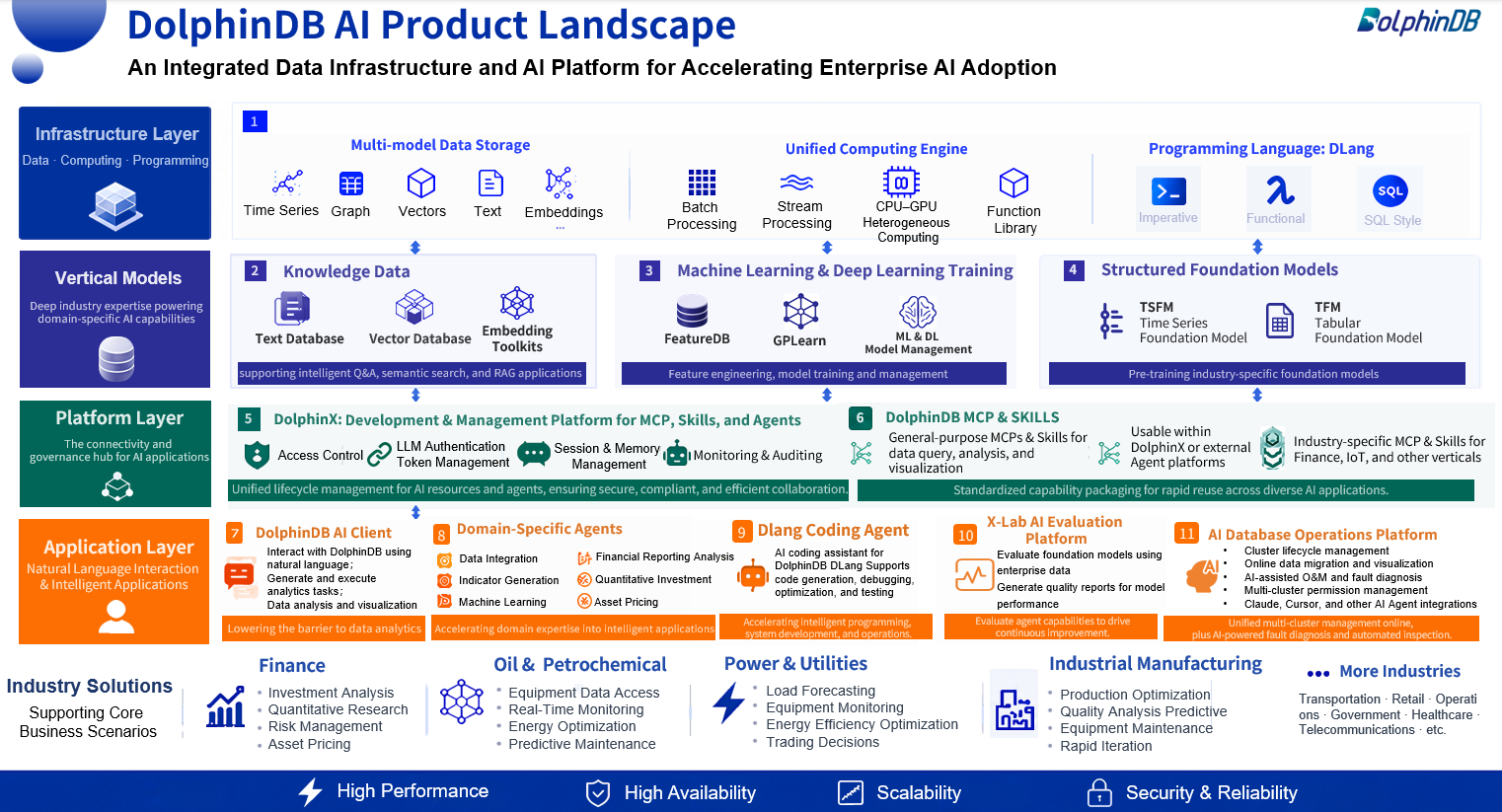
AI should not function as a black box—it must be verifiable, measurable, and accountable. To ensure the quality and reliability of AI-generated outputs, DolphinDB has developed an eight-dimensional evaluation framework covering result accuracy, code quality, tool utilization, debugging efficiency, and other key performance indicators. This framework makes AI outputs both measurable and continuously optimizable.
3. Engineering AI for Production
Having the right vision and technical approach is only the first step; successful deployment ultimately depends on engineering implementation. During the lecture, Dr. Zhou shared several real-world examples demonstrating how engineering frameworks enable reliable AI applications in quantitative finance.
- The AI Code Capability Evaluation System benchmarks leading domestic large language models using an eight-dimensional assessment framework. Its guiding principle is straightforward: the generated code must execute successfully, and the results must be correct.
- For the Strategy Backtesting Agent, rather than asking AI to generate hundreds of lines of backtesting code directly, the system instructs AI to produce a structured strategy configuration in JSON format, which is then executed through standardized system templates. By combining layered prompting, positive and negative examples, automated error correction, and AI-based validation, the strategy success rate increased from 84% to 99%.
- The FICC Pricing Agent addresses the complexity of pricing functions across different asset classes, where AI often struggles to determine the appropriate pricing methodology. By encapsulating pricing logic into structured Skills and applying layered testing, the solution doubled the task success rate while reducing execution time by 80%.
- The Research Report Reproduction Agent automatically extracts factor methodologies from research reports, generates executable code, performs backtesting and evaluation, and iteratively refines derived strategies. The workflow from research report to implementation can now be completed with minimal human intervention.
Across all of these examples, one conclusion stands out: engineering architecture—not AI models alone—is the true foundation for deploying AI in production. No matter how powerful AI models become, quantitative finance cannot compromise on stability, accuracy, or reliability. Constraining AI-generated outputs within a controllable intermediate layer while relying on engineering systems to ensure robust execution provides a more dependable and sustainable path toward AI adoption.
Following the lecture, students actively engaged in discussions on topics including the practical challenges of applying AI to quantitative investment, DolphinDB's technology roadmap, and the company's future product strategy. Dr. Zhou answered questions from the audience and shared insights drawn from both research and industry practice.
Looking ahead, DolphinDB will continue to advance AI-native financial infrastructure, empowering financial institutions to build reliable, scalable, and production-ready AI systems for the next generation of quantitative investment.