Are financial theory, factor models, and backtesting skills enough to conduct high-frequency trading research?
In practice, the gap between theoretical models and real-world implementation can be significant. Massive volumes of tick data, order book reconstruction, matching rules, and computational constraints all shape how a strategy performs in production. Closing this gap takes more than financial knowledge. It also requires hands-on experience with data processing, computational tools, and systematic research workflows.
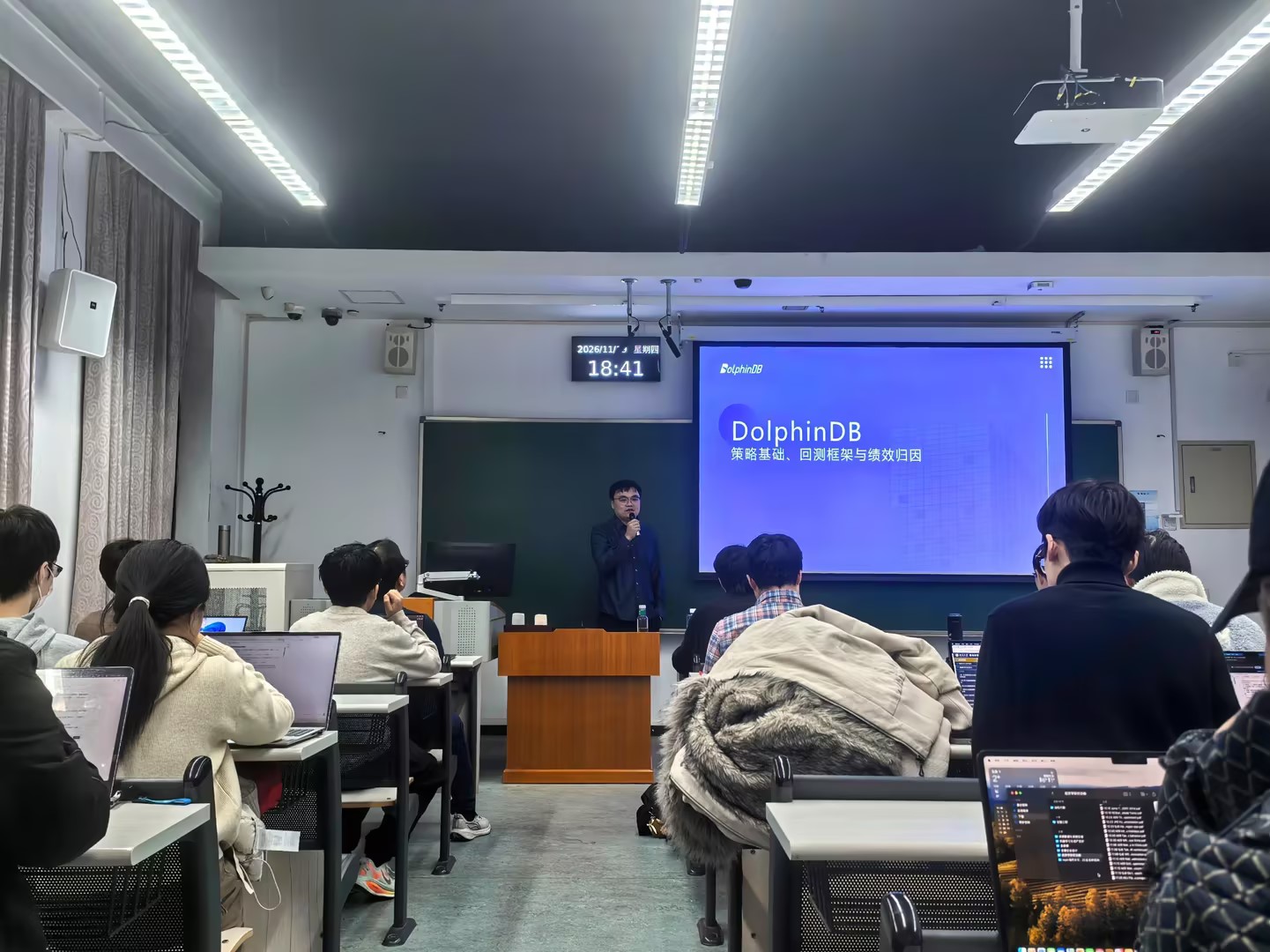
From October to November 2026, at the invitation of Dr. Xinping Li, Executive Director of the Financial Engineering Laboratory and Distinguished Research Fellow at Peking University's School of Economics, DolphinDB joined the university's High-Frequency Data and High-Frequency Trading course for four joint teaching sessions. The sessions covered high-frequency data processing, bar construction, order book analysis, factor development, and strategy backtesting, linking financial theory with the data infrastructure and analytical tools used in industry.
From High-Frequency Data to Strategy Backtesting
Designed for graduate and senior undergraduate students, High-Frequency Data and High-Frequency Trading focuses on market microstructure, high-frequency data, and quantitative trading systems. The course aims to equip students with the skills to process high-frequency data, develop trading strategies, and evaluate their performance.
The course combines academic instruction with industry-led technical training. University faculty establish the theoretical foundations of market microstructure and trading mechanisms, while DolphinDB brings practical tools and hands-on exercises into the classroom. Together, the two components provide a connected learning path—from understanding market behavior and processing high-frequency data to developing factors and validating trading strategies.
DolphinDB's sessions followed this progression, starting with the fundamentals of its programming environment and data analysis capabilities, then moving into factor construction and computation, and finally introducing strategy validation and backtesting. Through a combination of conceptual explanations and practical exercises, students explored how high-frequency data and computational methods support the broader quantitative research process.
Inside the Classroom: Connecting Data, Factors, and Strategies
Across the four sessions, the teaching focused on the data and computational challenges encountered in high-frequency quantitative research.
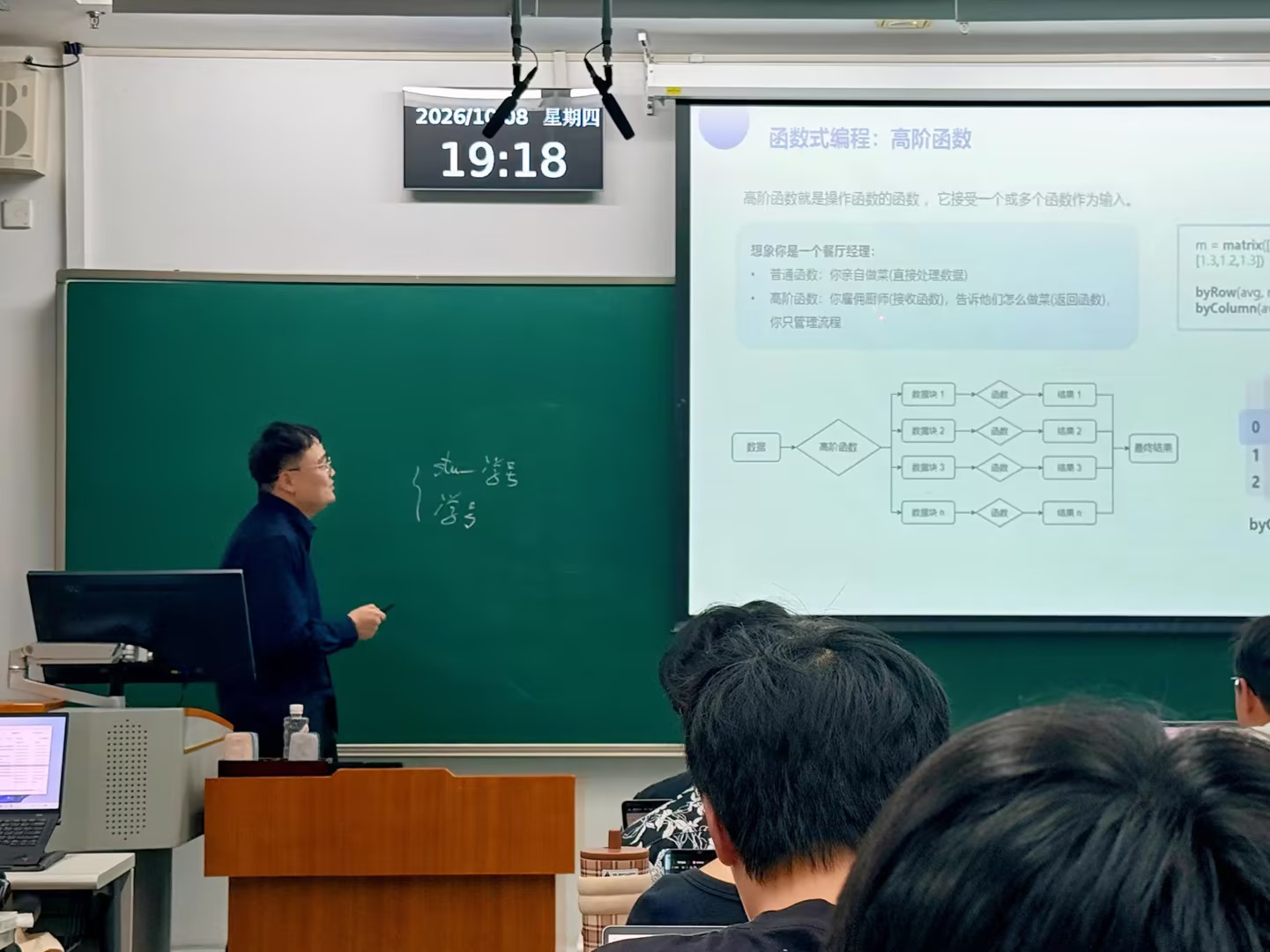
In the introductory session, DolphinDB Financial Solutions Manager Jin Wu introduced higher-order functions in functional programming. Flowcharts were used to illustrate the relationships between data, functions, and computational results, helping students understand key programming concepts and how they apply to data analysis.
As the course progressed, the focus shifted from data processing to factor computation and strategy backtesting. Students explored how factor research ideas can be translated into computational workflows, and how the resulting signals can be incorporated into quantitative strategy research.
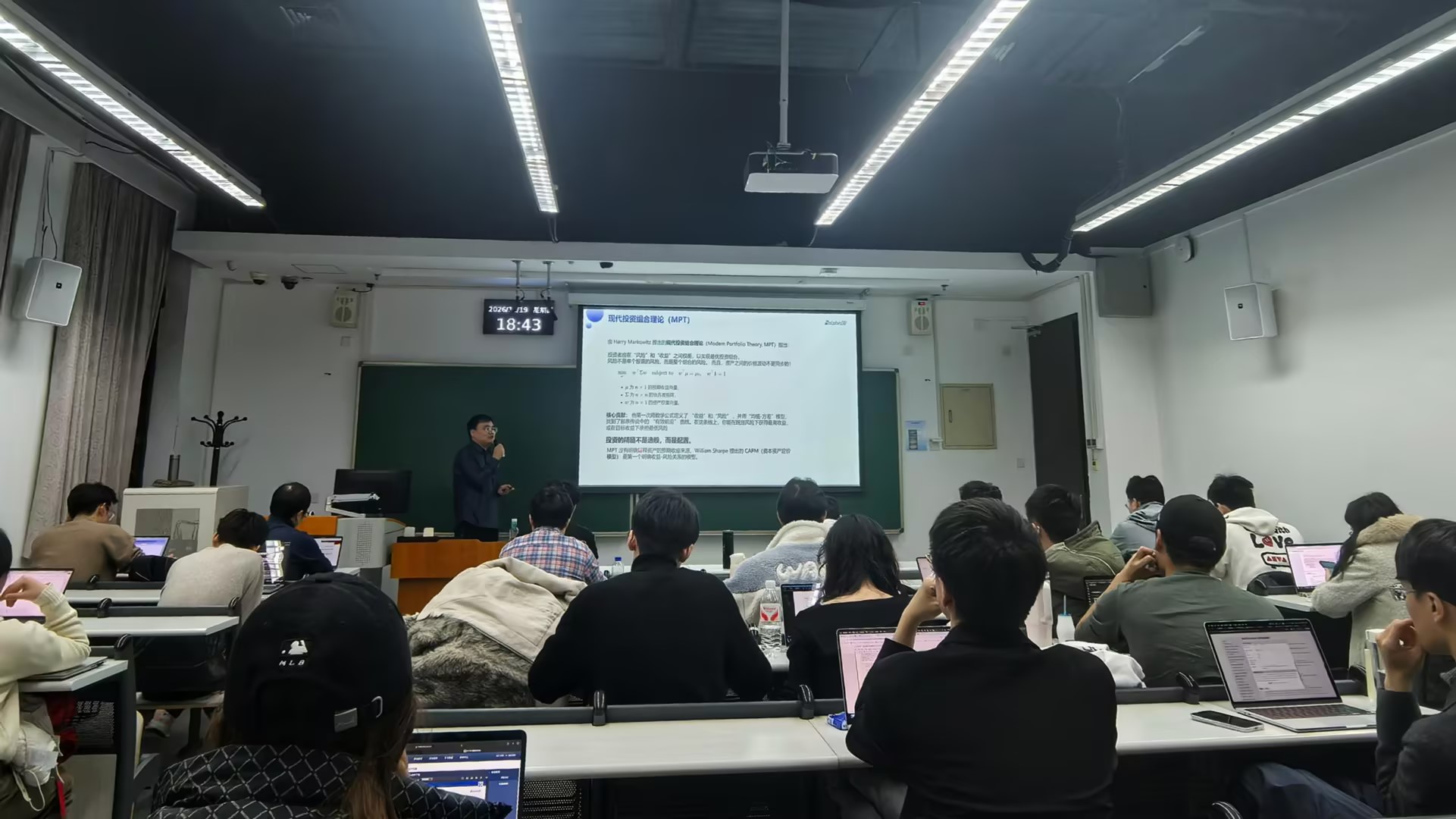
The strategy-related sessions further covered strategy fundamentals, backtesting frameworks, and performance attribution. Drawing on Modern Portfolio Theory, the course also extended the discussion to the relationships among investment returns, risk, and portfolio construction.
By bringing these topics together, the four sessions demonstrated how data processing, quantitative analysis, and financial theory fit into a practical research workflow.
Connecting Academic Learning with Industry Practice
Moving from understanding a financial model to applying it in actual research involves much more than implementing a formula. Data preparation, computational efficiency, engineering design, and strategy validation all play important roles.
As financial markets become increasingly data-driven, students benefit from opportunities to work with industry tools and gain exposure to real-world research workflows while still at university. Collaboration between academia and industry helps bridge this gap: universities develop students' theoretical knowledge and analytical capabilities, while industry practitioners contribute practical technologies, engineering experience, and insights into current business needs.
The four sessions at Peking University represent another step in DolphinDB's ongoing efforts to connect financial education with industry practice. By bringing high-performance time-series data processing and quantitative research tools into the classroom, DolphinDB aims to help students better understand how financial concepts translate into practical applications and build skills for future research and careers in quantitative finance.
DolphinDB will continue to expand its collaborations with universities, bringing industry experience into academic programs and supporting closer connections among education, research, and professional development.
About DolphinDB
DolphinDB is a high-performance distributed time-series database. Beyond efficient storage and querying of massive datasets, DolphinDB pioneers a fully featured programming language for complex analytics, alongside a high-throughput, low-latency, and developer-friendly stream processing framework — making it one of the most computationally powerful database systems available. DolphinDB is widely adopted by leading financial institutions across securities, fund management, banking, and insurance, as well as top enterprises in IoT-driven industries including energy, power, and industrial manufacturing — significantly enhancing large-scale data analysis efficiency and substantially reducing development costs.
DolphinDB Cerulean Campus Program
To advance university collaboration, DolphinDB has officially launched the Cerulean Campus Program — an initiative dedicated to bridging industry and academia through collaborative innovation and joint talent development. The program aims to integrate DolphinDB into university curricula and cultivate a new generation of fintech professionals equipped with global perspectives, innovative thinking, and hands-on expertise. Collaboration formats include guest lectures, curriculum development, talent training, and joint research, offering students access to rich learning resources, internship opportunities, and research topics.
To date, DolphinDB has established partnerships with a number of leading universities across China, including Shanghai Jiao Tong University, Peking University, Zhejiang University, Fudan University, Nanjing University, Renmin University of China, University of Science and Technology of China, The Chinese University of Hong Kong (Shenzhen), and more.